
Psychological testing
Psychological Testing
Comprehensive psychological testing for children, adolescents, and adults. Psychological evaluations can help clarify diagnoses, understand cognitive and emotional functioning, and guide treatment or academic accommodations, with reports that are easy to read and act on.
Our reports
No more digging through pages of narrative
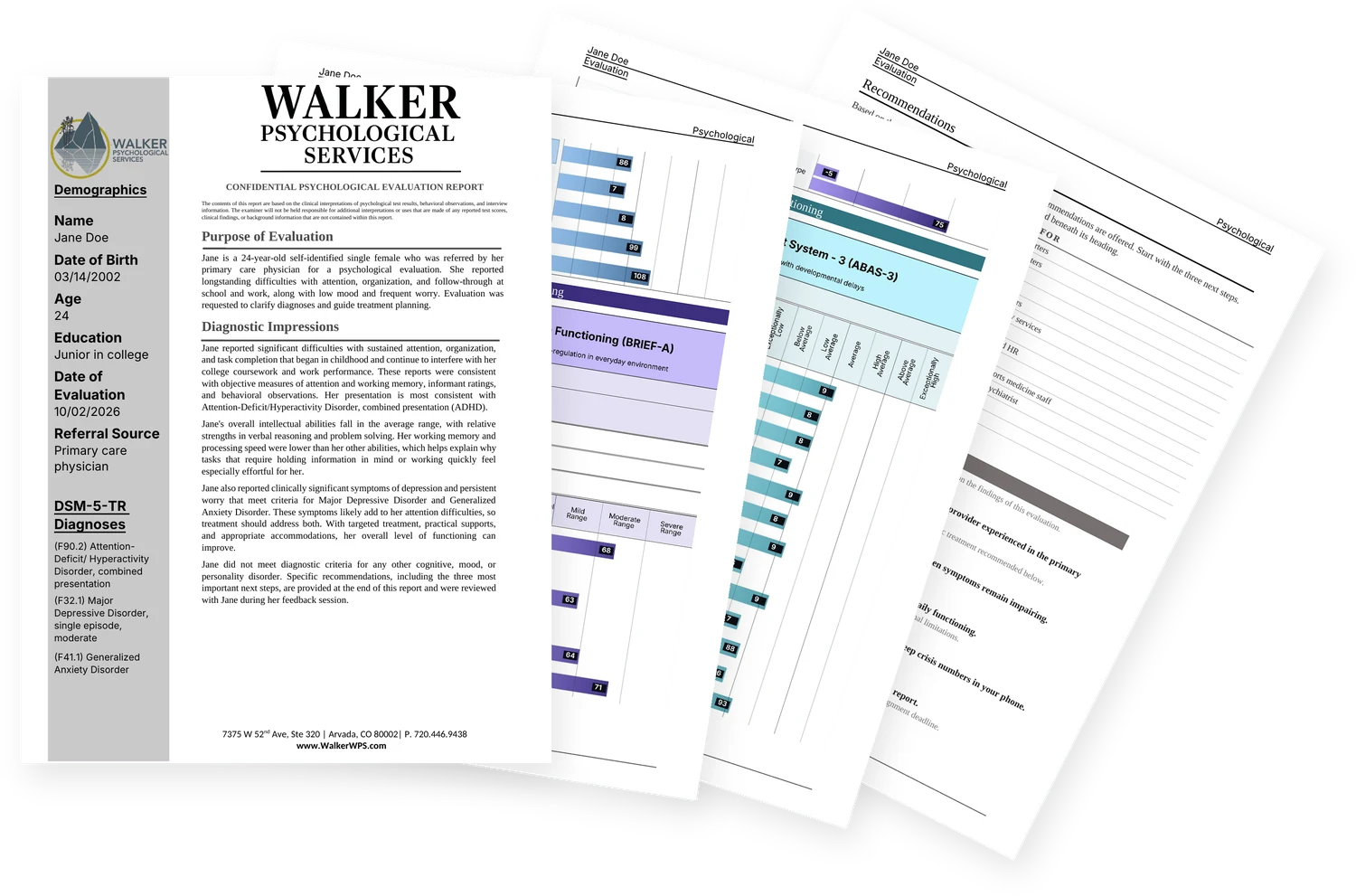
Most testing reports are long, dense narratives that are overwhelming to read, with the answers buried somewhere in the middle. Ours are built so you can find what matters in seconds.
Your answers on page one
Your diagnoses and a plain-language summary of what we found come first.
See your results at a glance
Every score is shown on a graph from well below to well above average, so strengths and challenges stand out.
Know what to do next
Recommendations start with the three most important steps, then are grouped by who they are for, each with a timeframe.
Written for you
Recommendations are tailored to your life, school, or work, not copied from a template. We walk you through it all in the feedback session.
At a glance
- No referral is required. Testing is available for individuals 8 years and older. For children ages 4 to 7, we recommend our partner practice, Rock Springs Psychological Testing Center.
- Testing typically takes 3 to 6 hours in total, depending on the purpose of the evaluation.
- Standard results typically take two to three weeks after testing. Same-day results are available for an additional $600.
- Remote testing is available for adults 18 and older. About remote testing.
- Many insurance plans cover psychological testing. Insurance does not cover learning disorder testing because it isn't considered medically necessary. See Insurance and Fees.
Our clinicians use evidence-based psychological tests and structured clinical interviews to develop a thorough understanding of each individual's strengths, challenges, and support needs. Psychological testing may be helpful for individuals experiencing difficulties with attention, learning, emotional regulation, or interpersonal functioning.
Types of evaluations
Attention-Deficit/Hyperactivity Disorder
Explores attention, organization, memory, and impulse control to determine if ADHD or another concern explains the difficulties.
Autism spectrum
Evaluates social communication, sensory differences, and behavior patterns for Autism Spectrum Disorder in children, adolescents, and adults.
Learning disabilities
Looks at reading, writing, and math skills alongside cognitive abilities to identify a specific learning disorder.
Mood, personality, and mental health
Clarifies emotional and psychological concerns when symptoms are complex or unclear.
Learning disability evaluations
Learning disability evaluations look at whether challenges in reading, writing, or mathematics may be related to a specific learning disorder. Testing may include measures of cognitive functioning, academic achievement, language processing, and memory and information processing. Results can help support school accommodations, individualized education plans (IEPs), or workplace accommodations. Insurance does not cover these evaluations because they aren't considered medically necessary. Learning disability testing and fees.
Mood, personality, and mental health evaluations
Psychological testing can also help clarify emotional and psychological concerns when symptoms are complex or unclear. Evaluations may look at anxiety disorders, depression and mood disorders, trauma-related symptoms, personality functioning, and behavioral concerns. Results provide insight into diagnostic considerations and help inform treatment planning and therapeutic recommendations.
What to expect during psychological testing
The evaluation process includes three steps.
Intake session (60 minutes)
This is the appointment you book. We review your background questionnaire and decide which tests are right for your evaluation.
Testing session (2 to 5 hours)
Standardized psychological tests and questionnaires, typically scheduled 1 to 2 weeks after the intake.
Feedback session (60 minutes)
Scheduled about 2 to 3 weeks after testing, once scoring and interpretation are complete. We review your written report and recommendations. See how our reports are organized.
How to prepare
- Get a good night's sleep.
- Eat a balanced meal beforehand.
- Bring past evaluations, school or work reports, and relevant medical records.
- Do not take any stimulant medication the day of testing.
Benefits of psychological testing
- Clarify diagnoses
- Understand cognitive and emotional strengths
- Identify learning or attention difficulties
- Develop targeted treatment plans
- Access academic or workplace accommodations
- Identify strengths and relative weaknesses to support performance enhancement
- Improve self-understanding and personal development
Testing provides objective information that helps guide effective support and intervention.
Testing questions
What is psychological testing?
Do I need a referral for psychological testing?
How long does psychological testing take?
How long is the testing process and when can I expect results?
How long until I receive my results?
How should I prepare for psychological testing?
Do you offer remote testing?
When should I see a neuropsychologist or neurologist instead?
What will my report look like?
Can my evaluation results be shared with my doctor, school, or employer?
Can psychological testing be redone if I disagree with the results?
Do you test children younger than 8?
For providers
Refer a client for testing
Physicians, therapists, schools, and other providers can send a testing referral through our secure form. We'll contact your client to schedule a testing intake, and we can let you know once it's scheduled with your client's consent.
Contact us
Contact the practice
Book a testing intake through the scheduler. For therapy, sport and performance, or a free 15-minute consultation, send a secure inquiry, call, or text.